Open 24/7 for emergency roof repair Serving all of Ottawa
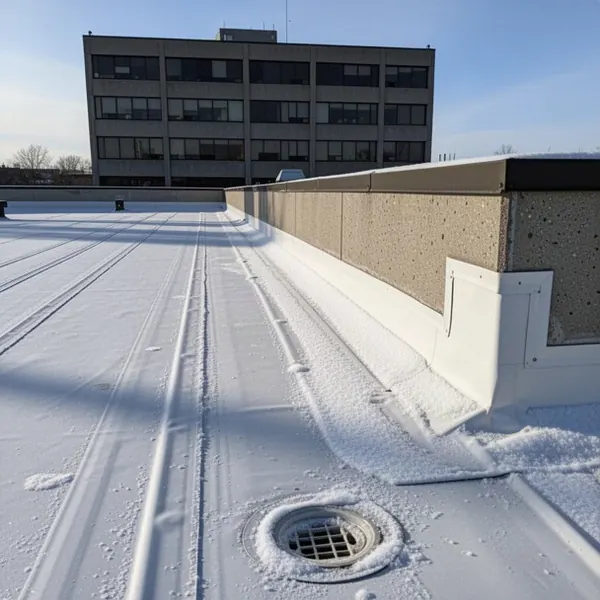
New TPO membrane roof on Barrhaven medical building

Single-Ply Membranes

TPO, EPDM and PVC Roofing in Ottawa

Ottawa Roofing Pros installs, recovers and repairs TPO, EPDM and PVC single-ply roofs on Ottawa offices, plazas, warehouses, restaurants and condominium buildings. We choose the membrane, its thickness and its attachment method around how your roof is actually used.

Our crews bring more than 17 years on Ottawa roofs and over 1,500 completed roofing jobs to every membrane we lay. We hot-air weld TPO and PVC, tape EPDM seams, and probe the laps before anyone signs off.

We are licensed, insured and WSIB-covered, and our phones are answered 24/7 when a membrane lets go in a storm.

Single-Ply Membrane Roofing: What We Install and Repair

Single-ply roofing is a low-slope roof covered by one layer of factory-made membrane, usually 45 to 90 mil thick, laid over insulation and joined at the seams on site. We install new TPO, EPDM and PVC systems, recover sound roofs with a new membrane, and repair single-ply roofs of any age or brand.

Our single-ply work falls into four groups:

  • New roofs and replacements: tear-off to the deck, new polyiso insulation, tapered crickets to the drains and a new membrane.
  • Recovers: a new membrane over an existing roof that a moisture survey confirms is dry.
  • Repairs: open seams, punctures, shrinking EPDM, failed curb and parapet flashings, cracked pitch pockets.
  • Add-on details: flashing new rooftop units, solar racking supports, pipe penetrations and roof hatches.

The buildings vary as much as the membranes. We work on tech offices along March Road as part of our commercial roofing in Kanata, warehouses in the Stittsville Business Park off Iber Road through our Stittsville roofing crews, and medical and retail buildings near Strandherd Drive with our Barrhaven roofers.

Single-ply is one of several systems within our commercial roofing services. When the whole roof is due, our commercial flat roof replacement page explains tear-off versus recover and phasing around tenants.

Comparing TPO, EPDM and PVC Membranes

All three membranes keep water out well when installed properly, so the choice comes down to seams, surface colour, what lands on the roof and budget. TPO is the most common pick for new commercial roofs in Ottawa, EPDM still covers a huge share of existing roofs, and PVC wins wherever grease or chemicals reach the membrane.

Property TPO EPDM PVC
Seams Hot-air welded Seam tape with primer Hot-air welded
Common thickness 45, 60 or 80 mil 45, 60 or 90 mil 50 to 80 mil
Standard colour White (reflective) Black (white available) White (reflective)
Puncture resistance Good, better at 80 mil Good, flexible; 90 mil for traffic Good
Grease and chemical resistance Moderate Poor: oils swell the rubber Excellent
Typical lifespan in Ottawa 20 to 30 years 25 to 30+ years 20 to 30 years
Relative installed cost Mid Lowest to mid Highest

For a deeper side-by-side that also covers two-ply SBS, read our TPO vs EPDM vs modified bitumen guide.

TPO: Heat-Welded and Reflective

TPO (thermoplastic polyolefin) is a white, polyester-reinforced sheet whose seams are fused with hot air into one continuous membrane. A good weld is stronger than the sheet around it, which is why TPO seams rarely fail when made right.

We favour 60 mil for most roofs and 80 mil where foot traffic is heavy or a longer warranty is wanted. Common systems include Carlisle Sure-Weld, GAF EverGuard and Elevate UltraPly.

The catch is repairability: weathered TPO needs scrubbing and a fresh surface before it will weld again. Older, chalky sheets sometimes need a cover strip rather than a direct weld.

EPDM: Proven Rubber Membrane

EPDM (ethylene propylene diene monomer) is a synthetic rubber sheet that stays flexible in deep cold. That is why so many Ottawa roofs from the 1980s and 1990s are still black rubber.

Modern EPDM seams use factory seam tape, such as Carlisle SecurTAPE or Elevate QuickSeam, instead of the liquid splice adhesive behind many old seam failures. We usually spec 60 mil, or 90 mil for high-traffic and long-warranty roofs.

EPDM's weak points are oils, which make the rubber swell, and shrinkage over time, which pulls flashings away from parapets. Both are easy to spot on a roof survey.

PVC: For Restaurants and Chemical Exposure

PVC (polyvinyl chloride) membrane resists animal fats, cooking oils and many industrial chemicals. It is our default near restaurant grease exhaust fans, food processing and lab exhaust, where EPDM and TPO break down faster.

PVC welds like TPO but must never touch asphalt or polystyrene insulation directly. Over an old built-up roof or foam board, we add a separator sheet so the PVC's plasticizers don't migrate out and leave it brittle.

PVC is also the usual membrane for insulated retrofits over aging steel roofs, covered on our commercial metal roofing page.

Attachment Methods: Fastened, Adhered or Ballasted

A single-ply membrane is held down in one of three ways: mechanically fastened, fully adhered or ballasted. The right method depends on the deck, the building's height and wind exposure, the structure's spare capacity and the budget.

Method How it works Best for Watch for
Mechanically fastened Screws and plates in the seam laps, with the next sheet welded over them Steel decks, large roofs, cold-weather installs Membrane flutter in wind; tighter fastener rows needed at edges
Fully adhered Bonding adhesive or low-rise foam glues the sheet to a cover board High wind exposure, complex roofs, quiet smooth finish Adhesives have minimum application temperatures
Ballasted Loose-laid sheet held down by river stone or pavers Large roofs with spare structural capacity Added weight; stone hides leaks and must be moved to repair

Wind uplift peaks at corners and perimeters, so fastener spacing tightens there by design. Assemblies are tested to CSA A123.21, the Canadian dynamic wind uplift test for membrane roofs, and we follow the manufacturer's tested pattern for your building height and exposure.

Ballast deserves a second look on older buildings. A ballasted roof adds roughly 10 lb per sq ft or more on top of Ottawa's snow load, so we confirm structural capacity before choosing it.

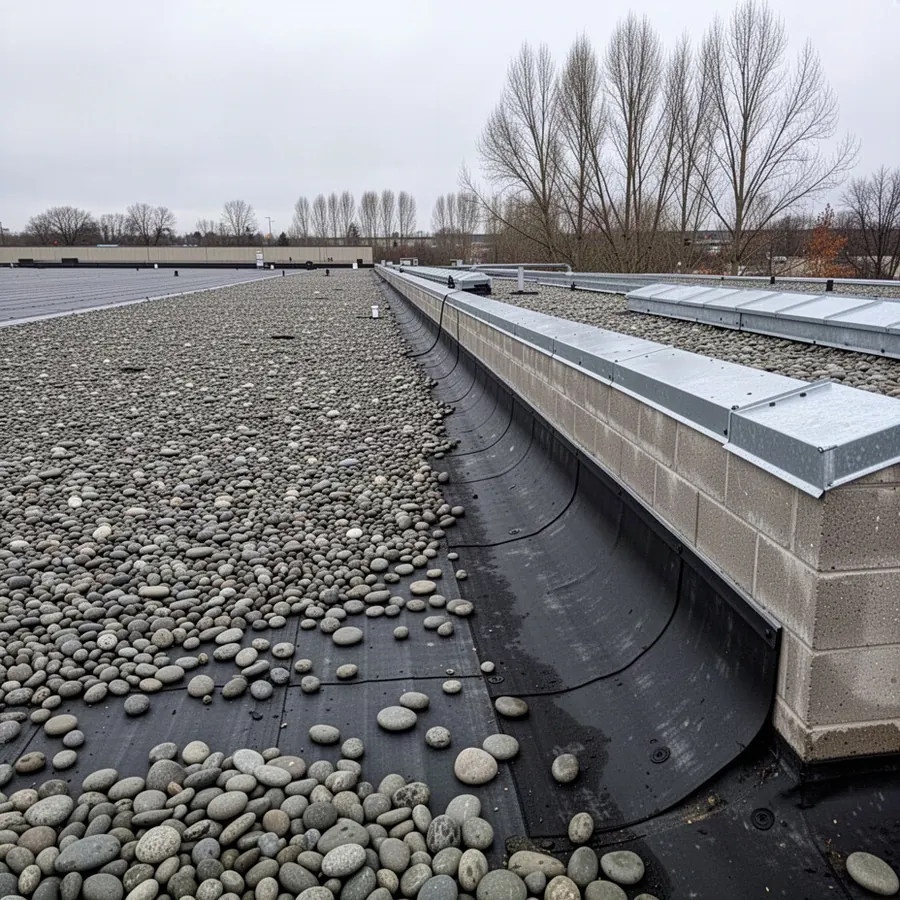
Ballasted EPDM roof with river stone on warehouse
Loose-laid EPDM held down with river stone ballast on a warehouse

How Single-Ply Performs in Ottawa Winters

Single-ply roofs perform well through Ottawa winters when the seams, flashings and drains are detailed for cold. The membrane surface swings from below -30°C on a January night to well over 60°C on a black roof in July, and every detail has to survive that movement.

Cold-weather seaming. TPO and PVC can be welded in winter on a dry, frost-free surface, with the welder's heat and speed adjusted and a test weld cut and peeled before production. Many bonding adhesives and seam primers carry minimum application temperatures above freezing, so winter adhered EPDM means cold-weather products, heated storage or waiting for spring.

Snow load and drifting. The structure carries the snow, not the membrane, but drifts against parapets, penthouse walls and rooftop units concentrate the weight. Ontario's snow loading alert urges owners to watch for sagging and cracking, and our commercial roof maintenance programs include winter drain and drift checks.

Thermal movement. EPDM can shrink with age and tug on base flashings, so perimeter securement at every wall and curb is not optional. Reinforced TPO and PVC are more dimensionally stable, but long runs still need proper termination bars.

White or black? On offices with server rooms, labs or heavy lighting, a white TPO or PVC roof cuts summer cooling load noticeably. In winter, snow cover and a low sun mean a white roof gives up very little heating benefit.
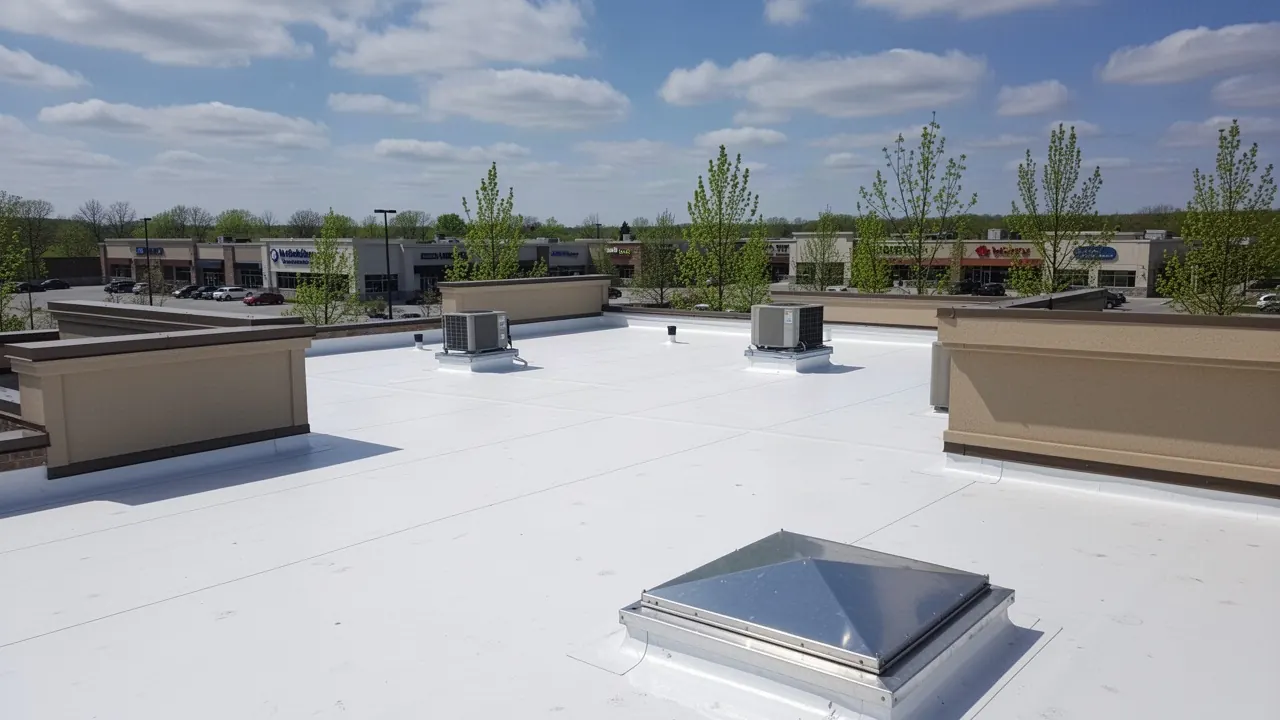
Welded TPO seams on snowy Nepean office roof
Heat-welded TPO seams and corner flashing after a January snowfall in Nepean

Single-Ply Installation Steps

A single-ply installation follows the same sequence whether the roof is 4,000 or 40,000 sq ft. A 5,000 sq ft tear-off usually takes 3 to 6 working days; a 20,000 sq ft roof takes about 2 to 4 weeks, depending on weather, tear-off layers and rooftop equipment.

Each step below has a sign-off before the next begins.

  1. Roof Survey and Core Cuts

    We map the roof, inventory drains and curbs, and take core cuts to confirm deck type, existing layers and insulation moisture. Infrared scanning flags wet areas on larger roofs.

  2. Membrane and Attachment Specification

    We match membrane type, thickness and attachment to your use, wind exposure and warranty goals. Insulation thickness and the tapered layout to each drain are set here.

  3. Tear-Off With Daily Dry-In

    We remove only what we can rebuild that day. Every evening, the open edge gets a temporary night seal so overnight rain stays outside.

  4. Insulation, Cover Board and Membrane

    A vapour retarder goes down first on heated buildings, then staggered polyiso layers, tapered crickets and a cover board where traffic or adhesion calls for it. The membrane follows, fastened or adhered to the tested pattern.

  5. Flashings and Penetrations

    Curbs, parapets, drains with clamping rings, pipe boots and roof hatches get membrane flashings and new metal coping or counter-flashing. These details cause most leaks, so they get the most time.

  6. Seam Probe and Close-Out

    Every weld is probed along its full length, and suspect spots are re-welded. Where a manufacturer warranty applies, their inspector walks the roof before we hand over photos and warranty documents.

Single-Ply Roofing Costs in Ottawa

Commercial single-ply replacement in Ottawa typically runs $10 to $18 per sq ft in 2026. On a 10,000 sq ft roof, that means roughly $100,000 to $180,000, with the actual price set by a written quote after a free assessment.

These factors move a project up or down the range:

  • Tear-off layers: stripping a gravel built-up roof or two old roofs costs far more than one single-ply layer.
  • Insulation upgrade: adding polyiso thickness or a tapered drainage package.
  • Membrane and thickness: PVC costs more than TPO, and 80 or 90 mil more than 60 mil.
  • Attachment method: fully adhered systems take more labour and material than fastened ones.
  • Details: each drain, curb, penetration and parapet adds flashing work.
  • Access: crane days, tight laneways and downtown street occupancy.
  • Season: winter work can add snow clearing and cold-weather materials.

Single-ply repairs follow our standard ranges: $350 to $1,200 for minor seam and flashing repairs, and $1,200 to $3,500+ for larger ones. Our commercial roof repair team handles active leaks around the clock.

Every installation carries our 1-year written labour warranty on workmanship. Manufacturer warranties are separate: they range from material-only coverage to system warranties of 10 to 30 years, depending on the product, membrane thickness, manufacturer inspection and registration.

Single-Ply Roofing FAQs

These are the questions owners and facility managers ask us most often when choosing a single-ply membrane in Ottawa.

Is TPO or EPDM better for an Ottawa building?

Neither wins everywhere. TPO suits offices and retail that benefit from a reflective roof and welded seams, while EPDM suits large plain roofs where cold flexibility and lower cost matter most.

If grease or chemicals reach the roof, PVC beats both.

Can a new membrane go over our existing roof?

Often, yes, if a moisture survey shows the existing insulation is dry, the deck is sound and the structure can carry the extra weight. Wet areas are cut out and replaced before the new membrane goes on.

How long does a single-ply roof last in Ottawa?

Most TPO and PVC roofs last 20 to 30 years and EPDM 25 to 30 years or more. Thickness, clear drains and twice-yearly inspections make the biggest difference.

Can single-ply roofing be installed in winter?

Yes, on dry and frost-free surfaces. Mechanically fastened TPO and PVC are the usual winter choices, since adhered systems depend on adhesive temperature limits.

Can our building stay open during the work?

Yes. We phase the roof into sections, seal it every night and schedule crane lifts and noisy tear-off around tenants, with notices you can send in advance.

Single-Ply Roofing Across Ottawa

Our crews dispatch from Centretown to every Ottawa community and anywhere within about 30 minutes of the city.

Free roofing estimate

Talk to a Membrane Specialist

Call (343) 504-9753 any time or send the form with your building address and roof size. We book a free assessment and follow up with a written membrane recommendation and quote.

Call (343) 504-9753
Call (343) 504-9753 Free Quote