Open 24/7 for emergency roof repair Serving all of Ottawa
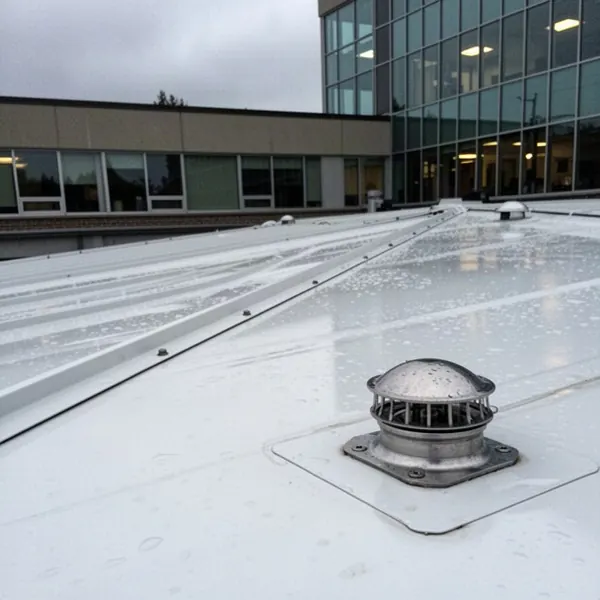
Commercial flat roof replacement on Ottawa warehouse

Commercial Re-Roofing

Commercial Flat Roof Replacement in Ottawa

Ottawa Roofing Pros replaces low-slope roofs on Ottawa offices, plazas, warehouses, condos and institutional buildings. We strip or recover the old roof, rebuild the insulation and drainage, and install a new TPO, EPDM, PVC or two-ply SBS membrane.

Our crews bring more than 17 years and over 1,500 roofing jobs to every project. That experience shows in the parts most re-roofs get wrong: wet insulation left in place, drains set too high and flashings too short for Ottawa snow.

We plan every commercial re-roof so the building stays open and dry, one section at a time.

Commercial Re-Roofing for Ottawa Buildings

Commercial flat roof replacement means removing or covering the old roof system and installing a new one, from the deck up. On most Ottawa buildings, that covers the insulation, the membrane and every detail where water gets in.

We replace roofs on single-storey plazas, Kanata North offices, east-end warehouses, schools, churches and low-rise condos. Roofs range from 2,000 sq ft to well over 50,000 sq ft. A complete scope from us includes:

  • Removal of existing layers to the deck, or preparation for a recover
  • Deck repairs on steel, wood plank or concrete, priced per sq ft in the quote
  • Vapour retarder, insulation and a tapered drainage package
  • Cover board where the membrane or traffic calls for one
  • The new membrane, with base flashings at parapets, walls and curbs
  • New or retrofitted drains, scuppers and overflow outlets
  • Raised curbs for rooftop units where flashing heights are too short
  • Metal coping, counter-flashing and walkway pads at service routes

We work across the city, from commercial roofing in Kanata to retail and office roofs in Nepean's Colonnade and Merivale Road areas and light industrial roofs handled by our Gloucester roofing crews.

Is It Time to Replace Your Commercial Roof?

A commercial roof needs replacing when the insulation is wet, leaks keep returning in new places, or yearly repair costs approach the cost of a new roof spread over its life. Age alone is a weak signal: a 25-year-old SBS roof can be sound while a 12-year-old poorly detailed TPO roof fails.

These are the indicators we look for:

  • Wet insulation: an infrared scan or core cuts show saturated board across large areas.
  • Repeated leaks: the same roof leaks after every thaw, even after spot repairs.
  • Membrane age and condition: brittle EPDM, crazed TPO, exposed scrim, or cracked SBS cap sheet.
  • Seam failures: laps opening along long runs rather than in one spot.
  • Rising repair costs: service calls every season, with no end in sight.

Here is the math we walk owners through. A 25,000 sq ft single-ply replacement at $12 to $16 per sq ft costs roughly $300,000 to $400,000 and should last 20 to 30 years. If the current roof needs $20,000 a year in repairs and is still leaking, five more years of patching costs $100,000 and leaves you with the same failing roof.

Wet insulation also loses much of its insulating value, so heating bills climb too. Our rule of thumb: when wet areas spread beyond about a quarter of the roof, or repairs no longer stop the leaks, replacement is the cheaper path. If the roof is still mostly dry, targeted commercial roof repair or a restoration coating may buy you several more years.

Tear-Off or Roof Recover?

A recover installs a new membrane over the existing roof, while a tear-off strips everything to the deck. A recover is only an option when the existing insulation is dry, there is just one roof on the building and the structure can carry the added weight.

That is why we never quote a recover without a moisture survey and core cuts. Wet board trapped under a new membrane keeps rotting the deck and voids most manufacturer warranties. Most manufacturers also will not warrant a new system over two existing roofs.

Weight matters in Ottawa because the structure must also carry heavy snow. An old gravel-surfaced built-up roof already weighs several pounds per square foot, so a recover over it may need a structural engineer's review. Structural repairs or changes generally need a City of Ottawa building permit; our Ottawa roofing permits guide explains when.

A recover saves tear-off labour and disposal and keeps the building sealed during work. The trade-offs are hidden deck damage and reduced flashing heights at doors, curbs and parapets. Where those heights drop below what the manufacturer details require, a tear-off is the better choice.

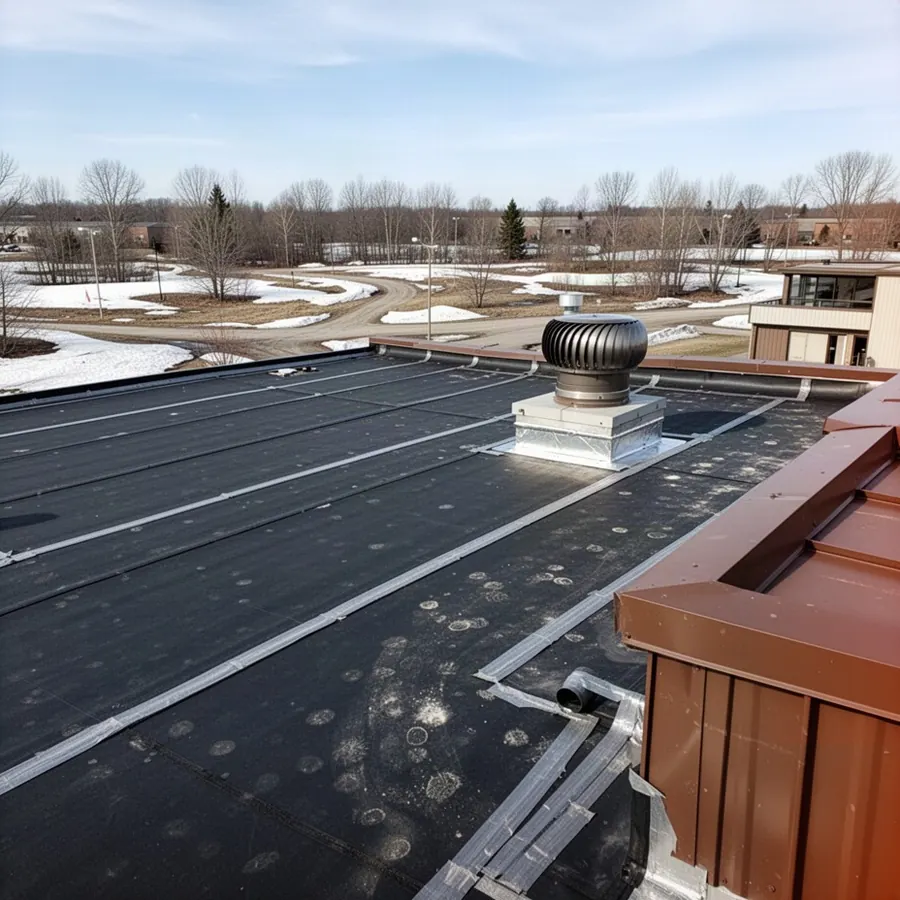
Recovered commercial roof with new EPDM in Gloucester
New black EPDM recover over an existing roof in Gloucester

Membrane System Options

Three families of membranes cover almost every commercial re-roof in Ottawa: single-ply, two-ply SBS modified bitumen and built-up roofing. The best choice depends on foot traffic, rooftop equipment, chemical or grease exposure, budget and how long you plan to own the building.

Our TPO vs EPDM vs modified bitumen guide compares them side by side. Here is how each fits a replacement.

Single-Ply TPO, EPDM or PVC

Single-ply roofs are one sheet, usually 60 or 80 mil, either mechanically fastened, fully adhered or induction-welded to plates. Products we install include Elevate (formerly Firestone) UltraPly TPO and RubberGard EPDM, Carlisle Sure-Weld TPO and Sure-Seal EPDM, GAF EverGuard TPO and Sika Sarnafil PVC.

PVC is our pick near restaurant exhaust because it resists grease. Details are on our single-ply TPO, EPDM and PVC roofing page.

Two-Ply SBS Modified Bitumen

Two-ply SBS is a base sheet plus a granulated cap sheet, torch-applied, self-adhered or cold-applied. Soprema's Sopralene and Sopraply lines and IKO's Torchflex and Modiflex are common Canadian systems.

It handles foot traffic and complex details very well. See our SBS modified bitumen roofing page for application methods and hot-work controls.

Built-Up Roofing

Built-up roofing (BUR) is layers of roofing felt and hot asphalt, finished with gravel. Many older Ottawa buildings still have it.

We rarely recommend new BUR on a full replacement, because SBS gives similar redundancy with less odour and kettle work. We do use built-up methods to match and extend existing BUR roofs.

Insulation, Drainage and Energy Performance

A re-roof is the cheapest moment to add insulation and fix drainage, because everything above the deck is being rebuilt anyway. Most of the roofs we strip in Ottawa have one or two inches of old fibreboard or polyiso, far below today's energy targets.

Ottawa falls in ASHRAE climate zone 6. In that zone, ASHRAE 90.1-2013 calls for R-30 continuous insulation entirely above the deck, and your designer confirms which Ontario energy path applies to the building. Polyisocyanurate (polyiso) gives roughly R-5.5 to R-6 per inch but loses some performance in deep cold, so we often recommend extra thickness or a mineral wool layer.

Tapered polyiso solves ponding, the standing water that stays more than 48 hours after rain. We design slopes of 1/4 inch per foot where height allows, with crickets between drains and behind curbs. Drains get new bodies or retrofit inserts set at the new roof level, plus overflow scuppers where the parapet allows.

Reflective white TPO or PVC cuts summer cooling loads on offices and server rooms. In Ottawa's heating-dominated climate, the bigger savings usually come from insulation thickness and air sealing at the roof-to-wall joint.
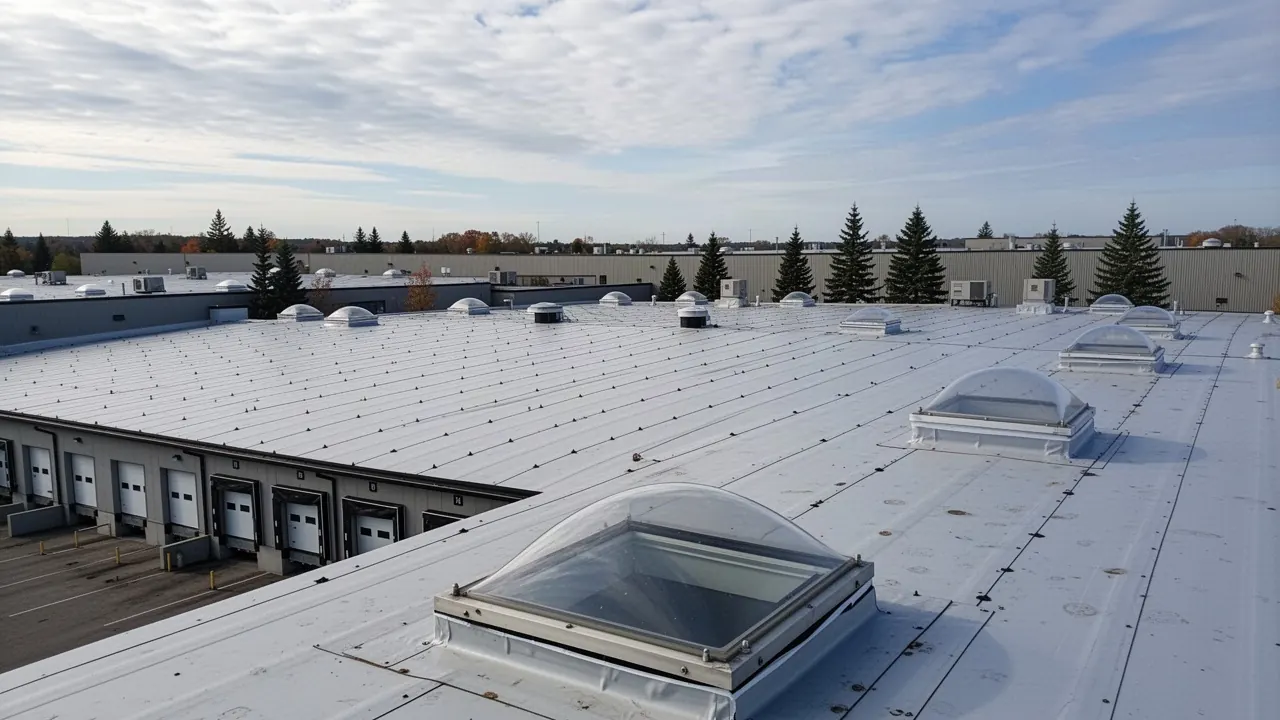
New roof drain and tapered cricket on Nepean re-roof
Tapered insulation cricket guiding water to a new roof drain

Re-Roofing Process and Tenant Coordination

Most commercial re-roofs take one to six weeks on the roof, depending on size, tear-off layers and weather. A 10,000 sq ft single-ply tear-off typically needs one to two weeks; a 40,000 sq ft warehouse can run four to six.

Late spring to early fall is the easiest window, but we also re-roof in cold weather with fastened or induction-welded systems, since many adhesives have minimum application temperatures. The six phases below stay the same year-round.

  1. Moisture Survey and Core Cuts

    We map the roof, take core cuts to confirm layers and deck type, and scan for wet insulation. This decides tear-off versus recover and prevents surprise extras.

  2. Specification and Submittals

    We write the specification: membrane, attachment, insulation, tapered layout, flashing heights and drain details. Product data, wind uplift design and manufacturer requirements go to you or your consultant for approval.

  3. Tenant Notices and Scheduling

    You get a schedule by roof section and a plain-language tenant notice covering noise, odour, parking and crane days. Noisy tear-off over sensitive spaces moves to evenings or weekends.

  4. Safety Plan and Hoisting

    We set guardrails or warning lines, a controlled hoisting zone and protected building entrances. Crane lifts happen early, with the lane closed and spotters in place.

  5. Phased Installation With Daily Dry-In

    We remove only what we can rebuild and seal that day. Every evening, the open edge gets a temporary seal so a surprise storm doesn't reach your tenants.

  6. Final Inspection and Close-Out

    We walk the roof with you, and with the manufacturer's inspector where a warranty applies. The close-out package includes photos, as-built notes, product data and warranty documents.

Budgeting for a Commercial Re-Roof

Commercial single-ply replacement in Ottawa typically costs $10 to $18 per sq ft in 2026. Where the roof qualifies, restoration coatings cost $4 to $9 per sq ft instead.

Option Typical Ottawa range (2026) What moves it
Single-ply tear-off (TPO, EPDM, PVC) $10 to $18 per sq ft Layers removed, insulation thickness, attachment method
Single-ply recover Toward the low end of the single-ply range Wet areas cut out, cover board, drain and curb changes
Two-ply SBS modified bitumen At or above the single-ply range Torch or cold application, detailing, hot-work controls
Restoration coating (qualifying roofs) $4 to $9 per sq ft Coating thickness, seam reinforcement, wet areas replaced

Other drivers include deck replacement, the number of rooftop units, crane days, access lanes and the warranty term. A free assessment and written quote set the actual price.

For capital planning, we suggest an assessment two to three years before you expect to replace. Budget a contingency for deck repairs, which we price as a unit rate so you only pay for what is found. Ontario's Construction Act holdback of 10% also applies to most commercial contracts, so plan cash flow around it.

Owners comparing home and building budgets can also check our Ottawa roof replacement cost guide.

Warranties for Commercial Roofs

Commercial roofs carry two kinds of warranty: the contractor's workmanship warranty and the manufacturer's warranty. Ours is a 1-year written labour warranty on workmanship, and we say so up front.

Manufacturer warranties range from material-only coverage to No Dollar Limit (NDL) system warranties. An NDL warranty typically covers repair of leaks caused by the membrane system or the installer's workmanship for 10 to 30 years, with no cap on the repair cost. It is only issued when an approved applicator installs the system, the manufacturer inspects the finished roof and the warranty fee is paid.

Every manufacturer warranty comes with conditions:

  • Timely notice of leaks, usually in writing
  • Regular maintenance and clear drains, with records
  • No alterations or new penetrations by unapproved trades
  • Exclusions for events such as winds above the rated speed, hail and building movement

A commercial roof maintenance program gives you the inspection records that manufacturers ask for at claim time. Visit our main commercial roofing services page for repair, coating and maintenance options.

Commercial Roof Replacement Questions

These are the questions owners, facility managers and condo boards ask before approving a commercial flat roof replacement in Ottawa. Each answer starts with the short version, then the detail behind it.

Can you replace a commercial roof in winter?

Yes, with the right system. Mechanically fastened and induction-welded single-ply roofs can go on in cold weather, and we tear off only what we can seal each day.

Snow must be cleared from each section first, and adhered systems wait for suitable temperatures.

Will our tenants need to move out?

No. We phase the roof into sections, keep entrances protected and dry in every night. Tenants under the active section may hear noise for a few days, which is why we schedule tear-off over sensitive spaces after hours.

Do we need a building permit to replace a commercial roof?

A like-for-like membrane replacement often does not, but structural repairs, deck replacement, new rooftop equipment or heritage properties can trigger a permit or approval. We check with the City of Ottawa during specification so the schedule accounts for it.

Do you replace commercial roofs outside central Ottawa?

Yes. We cover all of Ottawa and about a 30-minute drive beyond, including plazas and offices in Orléans and business and agricultural buildings around Stittsville.

Flat Roof Replacement Across Ottawa

Our crews dispatch from Centretown to every Ottawa community and anywhere within about 30 minutes of the city.

Free roofing estimate

Plan Your Re-Roofing Project

Send us the building address, approximate roof size and any reports you already have. We book a free assessment with core cuts, then send a written scope, phasing plan and fixed quote.

Call (343) 504-9753
Call (343) 504-9753 Free Quote